Critical Approaches Assignment 4
The genre that I have chose to write about is Action Adventure. The main film that I will be looking at while talking about the action adventure film genre will be the Indiana Jones film series which I think is one of the best examples of an action adventure film. The first Indiana Jones that is called Indiana Jones and the Raiders of the Lost Ark and it was released in 1981 and it was directed by Steven Spielberg. The protagonist in Indiana Jones is called Indiana Jones and he is played by Harrison Ford and he is defiantly meant to play the role of Indiana Jones which is his second most know character that he plays. The first know character that he plays is Han Solo from Star Wars which is another classic and iconic action adventure film.
This is a trailer for all of the Indiana Jones movie that have been released which are Indiana Jones and the raiders of the lost ark, Indiana Jones and the and the temple of doom, Indiana Jones and the last crusade and Indiana Jones the Kingdom of the Crystal Skull.
This is a trailer for all of the Indiana Jones movie that have been released which are Indiana Jones and the raiders of the lost ark, Indiana Jones and the and the temple of doom, Indiana Jones and the last crusade and Indiana Jones the Kingdom of the Crystal Skull.
Genre Characteristics
The genre characteristics for Action Adventure films are that the films main narrative in action adventure films are usually good verses evil ( protagonists verses antagonist ) and in by the end the protagonists triumph over the antagonist in most action adventure films.
The genre characteristics for the Indiana Jones films are mainly that Indiana Jones searches for a Treasure that has either been lost for a long time or that the antagonists has stolen it and he has to takes it and return the treasures. Another one is that Indy always has a companion that helps with him throughout the film and gets him into trouble usually by triggering a trap or being captured by the antagonist which he saves by the end. Also there is always a big fight scene between Indy and either the main antagonist or their henchmen which Indy always wins. Another one is that they travel to exotic and interesting places to find the treasure and fight the antagonists.
Codes and Conventions
The conventions for the Indiana Jones films are that they are set in big explore-able and exotic places, Antagonist and protagonist, Conflict,
Big fight scene at the end,
Cool vehicles, Fast paced, Loud sound effects and music,
Violence,
Explosions, Special Effects and Green Screen effects.
The conventions for Indiana Jones are his hat that we wears in every movie and is one of the iconic things about Indiana Jones another iconic thing that Indiana Jones has in every movie is his whip that he uses to defeat some if the antagonists and to get over certain obstacles in his path that he needs to get past to get his treasure. Another convention for Indiana Jones is his clothes since they fit the character and they look like he has been on a lot of big adventures. Another convention for Indiana Jones is for being brave and adventurous by not backing down from any obstacle or challenge in his even if it could end in certain doom for him and his friends.

The conventions for Indiana Jones are his hat that we wears in every movie and is one of the iconic things about Indiana Jones another iconic thing that Indiana Jones has in every movie is his whip that he uses to defeat some if the antagonists and to get over certain obstacles in his path that he needs to get past to get his treasure. Another convention for Indiana Jones is his clothes since they fit the character and they look like he has been on a lot of big adventures. Another convention for Indiana Jones is for being brave and adventurous by not backing down from any obstacle or challenge in his even if it could end in certain doom for him and his friends.
Mise-en-scene
Mise-en-scene is a french phase that means 'placed in the scene' which is what is shown in frame in each scene. Mise-en-scene can be split up into 5 different areas and they are setting and props, lighting and colour, body language and facial expressions, costume and positioning of the characters and props in the frame.
Firstly the costume that Indiana Jones wears is a fedora, a leather jacket, safari shirt, trousers, satchel and Indy boots and all these parts of the costume create Indiana Jones iconic look that everyone knows. Also the costumes for all of the other characters have a similar look to them, in the sense that they all fit the concept for the films have have an adventurer and explorer look to them or have an evil and antagonist look to them.
 For example in Indiana Jones and the Temple of Doom the main antagonist looks like an antagonist because he has a skull of an animal on his head, wears blood as face paint, wears a red and black costume which usually people think that they are evil when they wear them colours or have anything that are in red and black.
Secondly the setting and props in Indiana Jones are mainly set in exotic places where Indiana Jones looks for treasure, fights the antagonists or rescues the damsel in distress but sometimes they are set in places like Venice, Egypt and Berlin.

Another iconic location that was used in Indiana Jones and the Last Crusade is Al Khazneh in Petra.
Also the props used in Indiana Jones are mainly weapons, dead body parts and artifacts. The main weapons that are used Indy's whip and gun, guns that the antagonists use and swords which they mainly use for fight scenes but Indy also uses his whip as a tool to help him get across obstacles in his path or to save someone from falling off a cliff. They use dead boys parts like hearts, limbs and skeletons to show that there have been other adventurers that also tried to do the same challenges and obstacles but failed and when someone kills someone or they die.

An example of this is in Indiana Jones and the Temple of Doom when Mola Ram rips out someone heart.
 Another example is in Indiana Jones and the Raiders of the Lost Ark when they open the Ark one the main antagonists Major Arnold Tohts face melts off showing his skull with blood running down it.
Thirdly the lighting and colour in Indiana Jones are used to give the Indiana Jones films an old style adventure look to them by uses colour and the lights. Colour has certain effects for each different colour that all give a different meaning that helps to give each scene its own mood, look and feel.
An example of this is the colour red that represents evil, passion and danger, I have already said that the character Mola Ram wears red in his costume and on his head this suggests that he his the antagonist and he is dangerous which he is.

Another example is the colour black that represents power, fear and evil. The character Major Arnold Toht wears a black suit, black gloves, black shoes and a black hat. This suggests that he is evil, powerful and people fear him and he is powerful, evil and people do fear him.
Firstly the costume that Indiana Jones wears is a fedora, a leather jacket, safari shirt, trousers, satchel and Indy boots and all these parts of the costume create Indiana Jones iconic look that everyone knows. Also the costumes for all of the other characters have a similar look to them, in the sense that they all fit the concept for the films have have an adventurer and explorer look to them or have an evil and antagonist look to them.
For example in Indiana Jones and the Temple of Doom the main antagonist looks like an antagonist because he has a skull of an animal on his head, wears blood as face paint, wears a red and black costume which usually people think that they are evil when they wear them colours or have anything that are in red and black.Secondly the setting and props in Indiana Jones are mainly set in exotic places where Indiana Jones looks for treasure, fights the antagonists or rescues the damsel in distress but sometimes they are set in places like Venice, Egypt and Berlin.
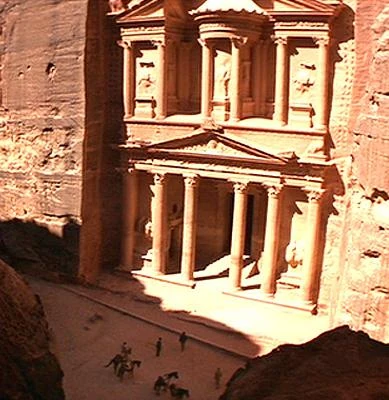
Another iconic location that was used in Indiana Jones and the Last Crusade is Al Khazneh in Petra.
Also the props used in Indiana Jones are mainly weapons, dead body parts and artifacts. The main weapons that are used Indy's whip and gun, guns that the antagonists use and swords which they mainly use for fight scenes but Indy also uses his whip as a tool to help him get across obstacles in his path or to save someone from falling off a cliff. They use dead boys parts like hearts, limbs and skeletons to show that there have been other adventurers that also tried to do the same challenges and obstacles but failed and when someone kills someone or they die.
An example of this is in Indiana Jones and the Temple of Doom when Mola Ram rips out someone heart.
 Another example is in Indiana Jones and the Raiders of the Lost Ark when they open the Ark one the main antagonists Major Arnold Tohts face melts off showing his skull with blood running down it.
Thirdly the lighting and colour in Indiana Jones are used to give the Indiana Jones films an old style adventure look to them by uses colour and the lights. Colour has certain effects for each different colour that all give a different meaning that helps to give each scene its own mood, look and feel.
An example of this is the colour red that represents evil, passion and danger, I have already said that the character Mola Ram wears red in his costume and on his head this suggests that he his the antagonist and he is dangerous which he is.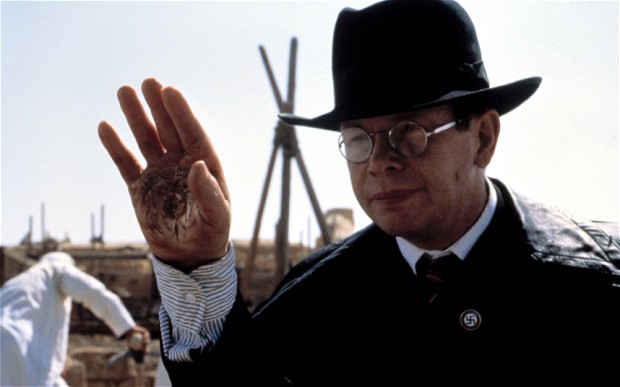
Another example is the colour black that represents power, fear and evil. The character Major Arnold Toht wears a black suit, black gloves, black shoes and a black hat. This suggests that he is evil, powerful and people fear him and he is powerful, evil and people do fear him.
Narrative Structure
The narrative Structure of Indiana Jones is a closed, single strand, anti-realist, linear narrative structure. This is all shown in the films for example in Indiana Jones and the Raiders of the Lost Ark the film is on for 1 hour and 55 minutes from beginning to the end and the time in the film is compressed and it lasts for about 1 month from when Indiana Jones first gets the golden idol in the temple to Indy looking for the Lost Ark to when the Ark gets put into a warehouse which takes about a month to happen. Also there is a small collection of center characters which are Indiana Jones, Marion Ravenwood, Dr Rene Belloq, Sallah, Major Arnold Toht and Colonel Dietrich. The film is single strand because there is only one narrative that is being throughout the film and it is being told in order of when each event takes places and there is no flashbacks, flash forwards or anything like that. Also it is an anti-realist narrative because the narrative is not realistic for example at the end when they open the Ark ghosts or spirits come flying out of the Ark and kill everyone that looks at them and melts off the face of Major Arnold Toht.
Narrative Structure of a story has an order that it follows which is goes in order Exposition-Rising Action-Climax-Falling Action-Resolution.
In Indiana Jones and the Raiders of the Lost Ark the Exposition when Indy goes to the Temple to get the golden Idol.
The Rising Action is when Indy is looking for the Ark and tries to find where it is.
The Climax is when the Antagonists tie up Indy and Marion, then open the Ark which kills everyone that looks at it when it opens.
The Falling Action is after everyone dies, Indy and Marion get back.
The Resolution is the end scene when Indy is talking to Marion about where the Ark is then you see it getting put into a storage warehouse.
Narrative Structure of a story has an order that it follows which is goes in order Exposition-Rising Action-Climax-Falling Action-Resolution.
The Rising Action is when Indy is looking for the Ark and tries to find where it is.
The Climax is when the Antagonists tie up Indy and Marion, then open the Ark which kills everyone that looks at it when it opens.
The Falling Action is after everyone dies, Indy and Marion get back.
The Resolution is the end scene when Indy is talking to Marion about where the Ark is then you see it getting put into a storage warehouse.

No comments:
Post a Comment